Europe

Belarus’ Failed Revolution and the 2025 Elections

Ciara Rushton | News Contributor

In the wake of the 2025 re-election of Belarusian President Aleksandr Lukashenko, opposition to the regime from within the country seems to have reached a standstill. Since the peak of Lukashenko’s vulnerability after the protests following the 2020 election, experts have sought to understand why the anti-regime movement in Belarus has gone from its strongest point since the early 1990s to having been effectively quashed. Experts have analysed internal developments in Belarus since 2020, arguing that these demonstrate that Lukashenko has mobilised the repressive apparatus of the Belarusian state on an unprecedented scale in the country’s history. Through ruthless repression, he secured his path to victory in 2025 without the challenges the regime suffered five years prior. 

In August 2020, amidst the COVID-19 pandemic, the world watched as the largest anti-government protests in Belarus’s post-Soviet history unfolded. The protests were led by independent presidential candidate Sviatlana Tsikhanouskaya, who claimed the 2020 election had been rigged against her. Opposition sources reported that over 250,000 people took to the streets on August 23 in the capital city of Minsk alone. Groups that had historically supported Lukashenko, such as pensioners and public sector factory workers, unexpectedly joined with the predominately university-educated urban opposition. The protestors argued that the 81% share of the vote reported by the Belarusian Central Election Commission was unfathomably high and could not be legitimate. Observers predicted that Lukashenko may fall and Belarusian democracy was on the horizon.  

In response to these protests, the government reacted sharply. Tsikhanouskaya and other opposition leaders were forced into exile in Lithuania. Protestors reported rampant human rights abuses, including threats of sexual violence from the police. In November of that year, months after the elections, over two hundred people were detained in Minsk on November 22 alone. 

International reactions to Lukashenko’s claimed win were swift but varied. The 2020 Moscow Mechanism report argued there was “overwhelming evidence that the presidential elections of 9 August 2020 [had] been falsified and that massive and systematic human rights violations [had] been committed by the Belarusian security forces in response to peaceful protests and demonstrations.” The EU imposed sanctions on Belarus for the government’s human rights abuses against the protestors. In contrast, Russian President Vladimir Putin sent his long-time ally Lukashenko a congratulatory telegram shortly after the elections. Whilst the West was united in its belief that the 2020 elections were fraudulent, Lukashenko could still rely on old friends for support. 

Despite the controversy surrounding the 2020 elections, President Lukashenko was inaugurated for his sixth term on September 23 that year. The following four years leading up to the January 2025 elections saw a continuation of the repression that characterised the government’s immediate response to the election protests. In 2021, Belarusian human rights monitors reported that over thirty thousand people had been detained for engaging in the protests. In 2024, leading up to the first elections in the country since 2020, the regime took further steps to ensure its strength, including engaging in a wave of arrests and raiding the offices of former election observers. Amnesty International has argued that a “suffocating climate of fear” has subsequently been created across Belarus. 

On January 26, 2025, four and a half years after the controversial 2020 elections, Lukashenko secured a seventh five-year term in office. Official results declared that he won with 86.82% of the votes cast, even higher than in 2020. Again, the West was united in its response, with a joint statement from Canada, Australia, the EU, New Zealand, and the UK condemning the elections as fraudulent. These countries also expressed further concerns that thousands remained unfairly detained as political prisoners over the course of the election and were subject to systemic and habitual torture. Likewise, Putin once again voiced his support for his close ally Lukashenko, congratulating him for his “resounding victory.” 

However, public unrest in Belarus this year has not been seen on a scale in any way comparable to that of 2020. Several rigorous measures have been key to the regime’s efforts to control the result of the elections. First, where in 2020 Tsikhanouskaya sought to pose a legitimate challenge to Lukashenko’s regime, the opposition was successfully kept off the ballot in 2025. Her “Coordination Council,” established in 2020 to facilitate a democratic transition in Belarus, was designated as an extremist group in January 2023, barring its candidates from running for office. The only candidates on the ballot besides Lukashenko were pro-government, including Sergei Syrankov, the leader of the Belarusian Communist Party, whose slogan was “Not instead of, but together with Lukashenko!” Furthermore, whilst the Organisation for Security and Cooperation in Europe was invited to observe the election, they were unable to do so as the Belarusian government only issued the invitation ten days prior to the elections. Combined with the aforementioned tight repression enacted by the government since the 2020 elections, this contributed to an electoral climate in which Lukashenko barely had to engage in any campaigning efforts. 

Franak Viačorka, an exiled Belarusian opposition leader, has argued that Belarus has transitioned from an authoritarian to a totalitarian country since 2020. The 2020 “revolution,” as some scholars describe it, has not resulted in a more democratic country, but was instead utilized and manipulated by Lukashenko’s regime as an opportunity to consolidate total power. 

Georgia, Belarus, and North Korea continue to support Russia’s war in Ukraine amid concerns over NATO

Autumn Perkey | News Contributor

As the conflict between Russia and Ukraine persists, Georgia, Belarus, and North Korea have demonstrated increased sympathy and support for Russia. North Korea, Belarus, and Georgia have each showcased violent and vocal support, including through supplying troops to assist Russia, prosecuting Ukrainian sympathisers, and appeasing Russia to reduce the threat of invasion. The conflict in Ukraine has also exacerbated tensions in border states, throughout Eastern Europe, and in parts of Asia. 

Russia’s February 2022 invasion of Ukraine led to one of the biggest intrastate conflicts since World War II, according to the Associated Press. Over the course of the war thus far, Ukraine has gained ground in Russia near Snagost in the Kursk region with hopes of pressuring Russia into a peace settlement or focusing Russian troops toward an Eastern deployment. According to a Ukrainian commander, they have gained control of roughly 1,200 square kilometre and 93 villages within Russia. One year into the conflict, a stalemate occurred with Russia slowly gaining ground, but at extreme costs. Given the confirmation of North Korean troops in the Kursk region, Belarus’s prosecution of Ukrainian sympathisers, and Georgia’s recent election of pro-Russia candidates, escalations seem likely. 

In Belarus, crackdowns on Ukrainian sympathisers have increased amid the continued conflict. In November 2024, Belarus arrested several hundred of its own citizens for sympathising with Ukraine. According to the Associated Press, of the 1,671 Belarusians detained, “at least 200…have been given prison sentences ranging from one to 25 years.” This recent effort follows previous crackdowns pre-invasion amidst the 2020 election of Lukashenko, during which security services conducted anti-riot drills and arrested 65,000 citizens in response to massive protests. Lukashenko’s crackdown was the result of his harsh authoritarian policies.

As Belarus instigates further crackdowns on those sympathetic to Ukraine, increased imprisonments and human rights abuses have drawn international attention. As of September 2024, Belarus has freed only 110 political prisoners, leaving at least 1,300 still behind bars—not including those arrested during the 2020 election. The United Nations has requested the release of several individuals imprisoned, including Ryhor Kastusiou, the leader of the Belarusian Popular Front, who was detained in 2021 and is being deprived of proper medical care for cancer. Belarus’s behavior toward political prisoners continues a long history of human rights abuses. If Belarus is left unchecked by either the United Nations or Western forces, it is unlikely Belarus’s behavior will change. Given Belarus’s previous support of Russia’s invasion of Ukraine in 2022, it is unlikely any attempts to appear diplomatic towards the United States or NATO are genuine. 

Continuing the trend of increasing support for Russia, Georgia’s government has now adopted a vocal pro-Russia stance. This pivot is surprising and contradicts popular opinion in Georgia as over 80 percent of Georgians polled support European integration. Aligning with a rogue superpower with widespread disapproval in the region runs counter to the majority’s preferences. 

This recent shift occurred after Georgia’s parliamentary election. Messaging from the Georgian Dream Party, which came to power in 2012, framed “angering Moscow” as a risk to Georgia.  According to the Washington Post, the message became “Align with the West and suffer Ukraine’s fate.” 

The involvement of North Korea in the ongoing conflict in Ukraine also risks further escalation. In June 2024, Russia and North Korea signed a mutual defence pact. NATO and U.S. intelligence confirms North Korean troops’s participation in the ongoing conflict. Sabrina Singh, Deputy Press Secretary for the Department of Defense, told Newsweek that “By bringing in another foreign country into the battlefield, by bringing in over 11,000 DPRK soldiers into the fight, that is an escalatory action.” President Zelensky has said that most North Korean forces have been killed, acting as “cannon fodder” in the ongoing conflict. 

North Korea’s support, Belarus’s punishment, and Georgia’s lean toward Russia pose escalatory risks in a currently deadlocked war. 

Given Russia’s escalation and the presence of North Korean troops, U.K. Prime Minister Keir Starmer, along with French President Emmanuel Macron, lobbied former President Biden for the approval of the use of Storm Shadow missiles. Along with the previous U.S. aid package, with confirmation of North Korea’s involvement, in November 2024, Biden approved the use of long-range ATACMS (Army Tactical Missile Systems), also known as Storm Shadow missiles, to strike inside Russia. The entanglement of regional allies risks further escalation and raises the question of what Ukraine’s allies can do to prevent North Korea’s intervention. 

Georgia offers an important lesson for states seeking to mitigate the risk of Russian expansionism. Georgia’s embrace of Russia has led to the U.S. reevaluating bilateral ties with Georgia. The U.S. has also frozen financial aid and ended any close military cooperation with the country. Georgia’s policy shift toward Russia might have been driven by NATO and the European Union’s exclusion of Georgia and Ukraine. Despite the threat of Russia looming for the last decade, a lack of response from NATO or the European Union will likely strengthen Georgia’s turn to Russia. Georgia’s change might necessitate a rethinking of NATO and U.S. strategy in the region. 

The lack of response from NATO will likely embolden North Korea to future participation and escalation given that lack of military response. Along with this, inaction by the United States will likely empower North Korea to continue gaining nuclear capabilities as there are no consequences for North Korea’s engagement.  

While Belarus has released 207 civilians from imprisonment so far, it is estimated that over 1,000 remain behind bars, even after the United Nations released statements condemning the imprisonment and saying that Belarus “should not be considered a safe country for anyone who ever showed disagreement with the government or its policies”.

The accumulation of the pro-Russia stances of North Korea, Belarus, and Georgia serves as potential tipping points in an already strife conflict. With the recent election in the United States and rumors of the country pulling out of NATO, we are likely to see continued instability and increasing support for Russia. 

Collapse and Corruption: Serbia’s Anti-Government Protests and the Demand for Accountability

Christine Savino | News Contributor

In recent weeks, Serbia witnessed significant anti-corruption protests, triggered when the canopy of the recently renovated Novi Sad railway station collapsed on November 1, 2024 and resulted in 15 fatalities. This disaster has been widely attributed to government corruption and substandard construction practices as part of larger infrastructure projects with Chinese state companies, leading to widespread public dissent against President Aleksandar Vučić and his administration.

The Novi Sad railway station renovation project, completed in July 2024, was a high-profile initiative under President Vučić’s administration and funded as part of China’s Belt and Road Initiative to enhance trade between China and Europe. Investigations spurred by the collapse revealed that contractors involved in the project had close ties to government officials, raising allegations of nepotism and improper awarding of contracts. Opposition parties have called for a comprehensive investigation into the project’s financing and the quality of materials used, which have been widely criticised as substandard. Radomir Lazović, co-chief of the Green-Left Front party, condemned Vesić by stating that he “is one of the people most responsible for massive corruption in construction, for the policy of secret contracts with investors, and this is now leaving behind human victims.”

In addition to dissent on the project itself, some have also critiqued the government’s response to the Novi Sad railway station collapse. Dragan Đjilas, leader of the centre-left Freedom and Justice Party (SSP), expressed frustration over the lack of arrests following the railway tragedy, stating, “People who attended protests have been arrested ... yet those truly responsible remain free.”

Allegations and instances of corruption have historically been a persistent issue in Serbia, with the country ranking in the bottom half of global rule of law indices. Throughout the 1990s, under Slobodan Milošević’s regime, corruption, and cronyism became endemic. The regime controlled the economy through state capture alongside international isolation, and heavily influenced the judiciary with political pressure and impunity for loyalists. Although the early 2000s saw various democratic reforms, such as the establishment of the National Anti-Corruption Council, many structural issues stemming from the regime persisted. Analysts have suggested that the concentration of power under Vučić’s leadership, including through reported Serbian Progressive Party (SNS) interference with the independent judiciary, has exacerbated these problems, undermining institutional independence and enabling corrupt practices. 

Protests and Public Response

The Novi Sad railway incident immediately prompted widespread protests across Serbia. Tens of thousands of citizens gathered in cities, including Belgrade, Novi Sad, Niš, and Kragujevac, to express their anger and demand accountability. In Belgrade, protesters rallied outside of government buildings, including the Ministry of Construction and Infrastructure, with banners reading “Corruption kills” and “Blood on your hands,” symbolising their frustration with government impunity. 

Serbian university students emerged as key organisers of the protests. They initiated strikes, suspended classes, and occupied university buildings to demand accountability for the Novi Sad disaster. On December 11, 2024, students rallied outside the chief prosecutor's office in Belgrade, urging legal action against those responsible for the disaster. This created logistical challenges for the government, prompting President Aleksandar Vučić to vow to meet all of their requests. 

Despite Vučić’s decision to agree to protestors’ demands, the month culminated in a large-scale demonstration on December 22, 2024 in Belgrade’s Slavija Square. This drew an estimated 100,000 participants, making it one of the largest protests in modern history. The protestors demanded President Vučić’s resignation and systemic reforms to address corruption. They marched through the capital, concluding with a sit-in outside the National Assembly, where they reiterated their demands. Miroslav Aleksić, president of the opposition party National Movement of Serbia (NPS), stated, “the most important thing now is for Serbia to stand up, because there is no restart without a general strike.”

Government Response

In response to mounting protests, President Vučić acknowledged the gravity of the tragedy and vowed that those responsible for the collapse would face consequences, stating, “competent authorities will establish who is criminally responsible for the tragedy that befell the country.” However, critics argue that the administration’s response has been insufficient and overly defensive, particularly since Vučić accused opposition parties of exploiting the tragedy to destabilise his government.

The government extended winter school holidays and suspended university classes, measures perceived by many as attempts to suppress dissent rather than address its root causes. Reports of arrests and alleged police violence against protesters have further fuelled public outrage. In December, the government heightened the presence of law enforcement at demonstrations and increased surveillance of protest organisers, leading to additional allegations of intimidation and heavy-handed tactics.

International Implications

The protests have potential impacts beyond Serbia’s borders. The European Union, which Serbia has formally aspired to join since 2012, has emphasised the importance of transparency and the rule of law. Serbia’s pursuit of EU membership is already complicated by strong connections with both Russia and China, the latter of which faced heavy criticism in the wake of the Novi Sad railway station collapse. President Aleksandar Vučić, emphasising Serbia's stance of political neutrality, has consistently vowed not to support Western sanctions imposed on Russia in response to its invasion of Ukraine. Likewise, lawmakers in Serbia’s national parliament are considering a draft law, inspired by Russia’s “foreign agents” legislation, which seeks to create a registry for organisations and individuals that receive over 50% of their funding from foreign sources. Critics within Serbia and abroad warn that the law could label civil society organisations as foreign entities, disrupt their activities, and threaten freedom of expression, raising concerns about its compatibility with democratic principles and EU standards. In addition, on 16 December 2024, Amnesty International published a report titled A Digital Prison: Surveillance and the Suppression of Civil Society in Serbia, alleging that the Serbian Police and the Security Information Agency (BIA) is utilising digital surveillance and repression tactics to subvert civil society , including the recent demonstrators. Denying the accusations, the BIA slammed the report as “nonsensical” and “absolutely incorrect.”

These setbacks for Serbia’s EU candidacy come amid broader challenges facing aspiring EU member states. For instance, in late December 2024, Bidzina Ivanishvili, founder of the ruling Georgian Dream Party, was sanctioned by the US for halting EU accession until 2028  due to Georgia’s pro-Russia policies and anti-government protests. Other Western Balkan efforts to join the EU are likewise facing significant obstacles, potentially signalling similar challenges for Serbia’s membership pursuit. In December 2024 alone, Bosnia and Herzegovina suspended EU integration due peace concerns, and Albania was marred with protests and warned by the EU that violence will not help it obtain membership.

Looking Forward

The anti-corruption protests represent a significant challenge to President Vučić’s administration, highlighting deep public discontent with alleged government misconduct, lack of transparency, and democratic backsliding. While Vučić retains support among specific segments of the population, particularly among older voters in rural areas, the scale and intensity of the protests, which have drawn diverse groups including students, activists, and opposition figures, underscore widespread dissatisfaction and potential impediments on the country’s long-standing pursuit of EU membership. This unrest could also impede  Serbia’s long-standing pursuit of EU membership, drawing attention to critical issues such as judicial independence, media freedom, and system corruption. The government’s ability to address protesters’ demands and implement meaningful reforms will be crucial in determining Serbia’s political trajectory.

A U-Turn in German Politics? Germany’s governing coalition collapses

Leah Ennis | News Contributor

On the evening of 6 November 2024, German Chancellor Olaf Scholz dismissed Finance Minister Christian Lindner, leader of the pro-business Free Democrats (FDP). This led to the collapse of the governing three-way “traffic light” coalition between Scholz’s Social Democrats (SPD), the Greens and the FDP, which had been in power for nearly three years. With the far-right Alternative für Deutschland (AfD) polling second at 18%, February’s snap election will likely usher in a u-turn and further polarisation in German politics.

A Planned Collapse?

Following the SPD’s narrow victory over the conservative Christian Democrats (CDU) in the September 2021 federal elections, this historic three-party government coalition, named after the colours of the respective parties, ended Angela Merkel’s (CDU) 16-year chancellorship. However, this novel governing arrangement—self-proclaimed as a “progress coalition”—soon faced unprecedented challenges, most notably Russia’s invasion of Ukraine in 2022, which caused a spike in energy prices and tested Germany’s commitment to NATO and the approximately 1.2 million Ukrainians seeking refuge in the country.

Amid these crises, ideological differences and rows over suspending Germany’s “Schuldenbremse” (debt brake), strained the coalition as Finance Minister Lindner blocked various government projects to exercise financial restraint. Tensions escalated over the 2025 budget, and Scholz accused Lindner of betraying his trust and prioritising party interests over the country’s, leading to Lindner’s dismissal. Subsequently, the FDP immediately withdrew all its ministers, except for Transport Minister Volker Wissing, who left the party but remained in the government, leaving the SPD and the Greens in a minority government. 

However, nine days after this fallout, on 15 November, an investigative article suggested that the FDP had been plotting the government’s collapse in what an internal communications paper called “Operation D-Day”. While Lindner, who did not anticipate being dismissed, maintains that Scholz had “calculated” the break-up, it is evident that the FDP had been threatening to pull the plug for weeks. Following media pressure, the party published its 8-slide presentation “D-Day Scenarios and Measures” on Thursday 28 November. This led the FDP’s General Secretary and Federal Managing Director to resign from their posts on Friday, sending the party into turmoil. Lindner, whose position in producing this paper remains unclear, has so far evaded calls from the other political parties, his FDP party colleagues, and the electorate to step down as party leader, instead tying his fate to the will of the electorate. Now polling only at 4%, below the 5% vote threshold required to enter parliament, the party may have ushered in its own demise.

On 16 December, Scholz lost a vote of confidence in the Bundestag, triggering his request for the dissolution of parliament and an early election, expected on 23 February 2025, seven months ahead of schedule. Federal President Frank-Walter Steinmeier now has 21 days to decide whether he agrees and calls a new election within 60 days.

The Current State of the Political Spectrum

German political parties across the board have gained new members since the coalition’s collapse, most notably the Greens with at least 20.000 new signups, but the CDU are predicted to win the next election, currently polling at 32%, with the far-right Alternative für Deutschland being the projected runner up. 

Friedrich Merz, leader of the CDU, is projected to become Germany’s next Chancellor. Returning to the Bundestag in 2021 when Merkel, often referred to as Merz’s “nemesis”, left and the “traffic-light” coalition took office, he drew the party back to the right and promoted a more conservative vision of governance. Despite the party’s popularity, the former supervisory board member of the German branch of Blackrock struggles to appeal to younger voters and women due to his anti-immigration rhetoric and controversial political track record (Merz voted against both the liberalisation of abortion and the criminalisation of marital rape in the 1990s).

The Eurosceptic and anti-immigration AfD has polled in second place for more than a year and has been gaining support since Germany’s “refugee crisis” in 2015-16. Five of the AfD’s youth organisations Junge Alternative’s (JA) regional chapters have been declared right-wing extremist movements by Germany’s domestic intelligence agency, and numerous others are currently under investigation. Earlier this year, an investigative report revealed that several high-ranking members of the AfD participated in secret meetings on “re-immigration”, which devised deportations on a mass scale and declared the intention of stripping ethnic minorities of German citizenship. Following their European election, candidate Maximilian Krah’s comments that not everyone in the SS (the Nazi regime’s main paramilitary force) was a criminal, the French far-right Rassemblement National announced it would no longer sit together with the AfD in the European Parliament. Krah’s aide was arrested on suspicion of spying and Krah himself was investigated for receiving payments from Russian and Chinese sources. Yet, the party has maintained its popularity, not least due to its effective use of social media. 

In contrast, the political Left has gone through a turbulent time. The former Left party leader Sahra Wagenknecht founded her splinter party, the Sahra Wagenknecht Alliance (BSW), in January 2024. Her pro-Russian and anti-immigration rhetoric has gained traction amongst the electorate and her party is predicted to cross the 5% of vote threshold required to enter the Bundestag. Meanwhile, the Left party, from which BSW seceded, is fighting for its survival. Given the party’s perilous poll numbers at around 3%, three of its most senior members are hoping to exploit a loophole in the constitution which allows a party to circumvent the 5% threshold by seeking re-election through direct mandates in their constituencies.  

Forming a coalition will not be easy and may require an unprecedented alliance. Although various governing coalitions on the state level provide “successful” options, such as the CDU-Green governing coalitions in Germany’s most populous state, North-Rhine-Westphalia, a national two-party coalition may not be able to establish a governing majority as all mainstream parties uphold the “Brandmauer” (firewall) against the hard-right AfD. Recent elections in the east of Germany, where the AfD gained most votes, have produced historically new partnerships, notably Germany’s first “blackberry” coalition between CDU, SPD and BSW in Thuringia. 

Turning to the Right 

The rise of the AfD and BSW is changing German politics. In response, public discourse and party positions have already been moving to the right. The progress coalition’s introduction of border controls against “illegal migration” in September of this year has certainly marked a U-turn from Merkel’s “welcoming” politics towards refugees and asylum-seekers in 2015. While the fear of increasing immigration to Germany is rising, according to a recent study, there is a simultaneously growing fear among Germans of the AfD coming to power. 

In May, teenagers who had attended a far-right rally of the neo-nazi Freie Sachsen conducted an unprecedented violent attack on the SPD’s European Parliament candidate for Saxony, Matthias Ecke. This has led to increased warnings about the far-rights’ tolerance of political violence. The incumbent Saxon CDU member of parliament Marco Wanderwitz has said he will not stand in the February elections out of fear for his family’s safety.  

In the September elections in Thuringia, the AfD became the strongest party in a federal state for the first time. Following the AfD Alterspräsident’s (senior president) refusal to hold a vote on the CDU and BSW’s joint proposal to change the rules of procedure to prevent the AfD from being able to nominate the President of Parliament as the largest parliamentary group, the Constitutional Court had to be called. The CDU politician Andreas Bühl, who made the call, accused the AfD politician Jürgen Treutler of “seizing power” and demanded his resignation from the post of senior president while other opposition parties accused the AfD of playing with democracy. 

Increased concerns regarding these developments led to cross-party support for launching prohibition proceedings against the AfD’s existence as a political party, which many legal experts believe would be successful given the collected evidence. It is unlikely, however, that the proposal, signed by at least 100 different parliamentarians, will be voted on before the new federal elections as the change in classification of the AfD from a mere suspected case to “definitely extremist and anti-constitutional” by the Federal Office for the Protection of the Constitution, which was expected for the end of the year and would have provided stronger evidence, will no longer take place to ensure equality of opportunity for all parties ahead of the elections. Meanwhile, the AfD seeks to part ways with the JA and establish a new youth organisation, presumably to avoid a more likely prohibition proceeding against the association.

In light of international geopolitical crises and Germany’s stagnating economy, these political developments are of international concern. The stakes are high as Germany’s next government, likely led by the CDU, will be influenced by the activities of the far-right and the electorate’s polarisation. In any case, it will present a U-turn from the politically liberal traffic light government back to the CDU and-—as many fear—to possibly darker days.

Pay attention to Ukraine, big changes are happening

Roy Shinar Cohen

You may have recently noticed increased attention to the Ukraine War by media and world leaders. In the two and a half years since Russia invaded the country, hundreds of thousands have died, and millions have fled. While Russia confirmed the death of 50,000 of its soldiers, Western intelligence services estimate the Russian death toll at half a million. On the Ukrainian side, at the War’s two-year mark, President Zelenskyy confirmed that 31,000 soldiers died. But, considering the substantially larger Russian casualty assessments, the number could be higher. These jaw-dropping numbers keep growing, as the war continues and Russian troops advance to Kharkiv, Ukraine’s second-largest city, and make some of their most substantial advances since the war began. This, however, brings us to the incredibly dangerous current situation.

President Zelenskyy visiting the east of Ukraine. December 6, 2021. Credit: rawpixel.com, CC0 1.0.

Russian troops began a summer offensive on the city of Kharkiv on May 10th. Kharkiv is Ukraine’s second-largest city located in the northeast, near the Russian border. Before the war, it housed 1.5 million people, and earlier this year this number was reported at a million. Now, after months of attacks against the city’s infrastructure, including the power grid, Russian troops are within artillery range of the city itself. According to Colonel General Oleksandr Syrskyi, Russia is amassing troops near Kharkiv from other regions, and training for further operations, though Russia does not year have the capacity to capture the city itself.

Map of Ukraine. Credit: Wikipedia, CC BY-SA 3.0.

Time, however, may be playing into Russia’s hands. According to Dara Massicot, a senior fellow in the Russia and Eurasia Program at the Carnegie Endowment for International Peace who was interviewed by The New Yorker, the Russian strategy is “to make life in [Kharkiv] unpleasant” and encourage people to leave the city. An element of this tactic has been to target the city’s electricity, water, sewage treatment, and television infrastructure. In addition to the Russian offensive, in recent months Ukraine has faced challenges enlisting recruits and has confronted fears of ammunition shortages, although the latter has been temporarily relieved by the recent 61 billion-dollar American aid package. Nevertheless, the recent Russian advances in the northeast are worrisome to Ukrainian and Western leaders.

Russian President Vladimir Putin aroused further alarm in a recent tactical nuclear weapons drill near the Ukraine border. The drill, which was held on May 21st, was deemed a response to increased Western involvement in the war and a warning against further escalation. Russian troops rehearsed the loading of launch vehicles, driving to launch sites, and loading planes with hypersonic missiles, all of which were done in the Rostov-on-Don region near the Ukrainian border. Before that, at the Russia Victory Day parade on May 9th Putin said the country’s “strategic forces” are always combat-ready.

Amid all this, Zelenskyy pleaded for more Western support, while the country awaits the much-needed American aid approved in late April. Apart from arms shipments, since May 13th, the West has been weighing a major shift in policy: allowing Ukraine to carry out attacks within Russian territory, which many fears could provoke a severe Russian escalation. The first to announce such a change, before Zelenskyy’s plea to the US on the matter, was UK Foreign Secretary Cameron during a visit to Kyiv on May 3rd. He said it is up to Ukraine to decide how it uses the weapons the UK provides, including the pursuit of targets within Russian territory.

Soon thereafter, more leaders announced their support for ending targeting restrictions. During an interview for The Economist on May 24th, NATO Secretary General Jens Stoltenberg joined Cameron in calling upon NATO allies to permit Ukraine to strike Russian territory. France’s President Macron joined the call on May 28th, and the next day Politico reported the German government was “cautiously ditching its reservations about allowing Ukraine to hit military targets inside Russia.” As more countries announced support for the policy change, pressure built on the Biden administration to make up its mind on the matter. However, according to American officials, after a long series of deliberations with advisors, Biden has reached the same conclusion.

Zelenskyy and Stoltenberg in Brussels, 2019. Credit: President.gov.ua, CC BY 4.0, via Wikimedia Commons

Finally, on May 30th Politico reported that Biden secretly allowed Ukraine to strike targets within Russian territory near Kharkiv. The US still prevents Ukraine from performing long-range strikes within Russian territory or hitting civilian infrastructure. The importance of this change is Ukraine can now better defend itself. On the one hand, it can use the weapons the US and many other NATO countries provide to shoot down rockets and missiles targeting Kharkiv. On the other hand, it can attack troops and bases on the Russian side of the border to try and prevent the troop buildup aimed at the city. According to The New York Times, the decision is the first time an American President “allowed limited military responses on artillery, missile bases and command centers inside the borders of a nuclear-armed adversary.”

The US characterises such strikes as self-defence. According to an American official, the policy means Ukraine can “use U.S.-supplied weapons for counter-fire purposes in the Kharkiv region so Ukraine can hit back against Russian forces that are attacking them or preparing to attack them.” Moreover, American officials told The New York Times that if Russia would launch attacks on Kharkiv from deeper within its territory “the president’s restrictions could be subject to further loosening.” This led a senior American official to conclude this is a “new reality” and “perhaps a new era” in the Ukraine War.

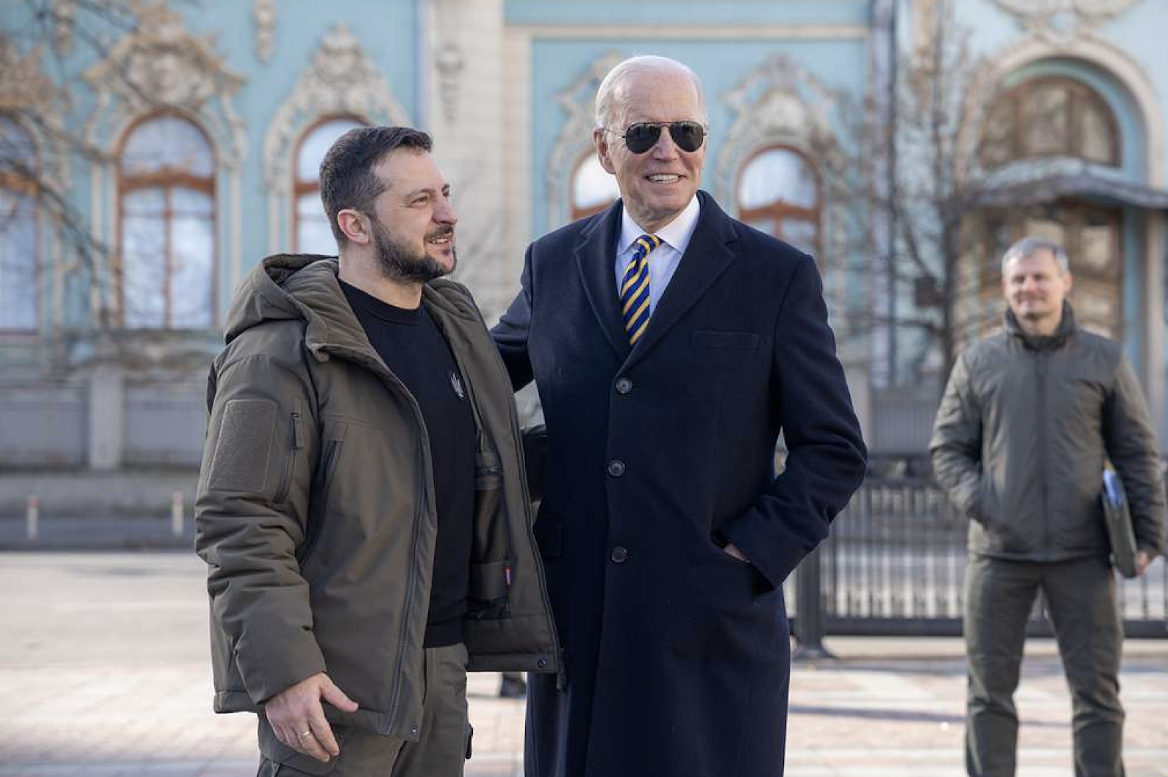
Biden and Zelenskyy in Ukraine in 2023. Source: Executive Office of the President of the United States, PDM 1.0

In addition to allowing Ukraine to hit targets inside Russia, Western states are expected to announce further measures of support. First, France is seeking partners to train Ukrainian troops within Ukraine, according to reports. Until now NATO countries have trained approximately 100,000 Ukrainian troops in allied countries. This is expected to ease personnel shortages faced by the Ukrainian military. More importantly, the US and Ukraine are close to signing a bilateral security pact, which would be the most significant such agreement Ukraine has signed with a NATO country. The pact is expected to be signed next month on the sidelines of the G7 summit in Italy and will lay out long-term commitments to Ukraine’s security.

These developments lead to the simple, yet crucial, conclusion that we are at an extremely risky point in time. Russia’s advances threaten Ukraine’s second-largest city and are reshaping the frontline dramatically with immense human costs. In parallel, the Western consent to use their weapons against Russian territory is a substantial escalation. This policy comes as the risk to Kharkiv is increasing and Russian troops are moving further within artillery range of the city. Since Russia knew the Western policy prevented Ukraine from hitting its territory, it built many important bases for its offence right behind the Ukrainian border. Accordingly, a senior American official described the Russian border in that region as an “artificial line” dividing the battlefield that kept Ukraine from responding to Russian attacks. Allowing Ukraine to attack within Russian territory will provide it with more strategic depth around Kharkiv and let it hit important Russian targets. Ukraine and its Western allies believe these attacks will help push the Russians back and ensure Kharkiv’s safety.

The substantial risk with this policy is the Russian response. It will test Russia and the escalation ladders at a time when, as mentioned above, Russia has been flexing its (nuclear) muscles. We should assume secret messages, or at least signals, have been conveyed between Washington and Moscow and analysts worked extra hours assessing escalation avenues. Yet miscalculations are always a danger, and when between nuclear states, they are even more paramount to avoid.

Additionally, these changes are happening in the months leading up to three important elections: the European Parliament next week (June 7-9), the British general election (July 4th) and the American election (November 5th). All of these will, inevitably, lead to some internal political instability (or, as we saw on January 6th 2021, more than “some” instability). This is especially true considering that, for the most part, the Republican party accepted Trump's refuted claims about election fraud in 2020, and top Republicans are spreading allegations of fraud in the upcoming election. Furthermore, they hold the potential for substantial policy changes towards Ukraine, especially in the American case if former President - and as of yesterday, convicted felon - Donald Trump were to emerge victorious. Accordingly, the current Western push to aid Ukraine may be seen as one of the final few before the tide in Washington changes and Putin may finally get his way.

Even though the world seems to be burning for so many reasons, the current state of the Ukraine war may be among the most important. The war has already cost the lives of hundreds of thousands and has caused millions more to flee. Ukraine is imminently expected to launch a Western-backed counter-offensive, including in Russian territory, to defend Kharkiv. However righteous this resistance may be, it risks substantial escalation with a nuclear power that does not seem to play by the normal rules. As Oxford’s Timothy Garton Ash recently said, people are “absolutely right to be deeply, deeply concerned about what is happening in Gaza, but I would ask them not to forget about what is happening in the Ukraine.”